Guide
The story
Trelleborg is the best-preserved of the ring fortresses raised across the realm during the reign of Harald "Bluetooth" Gormsson, the king credited on the Jelling stones with uniting Denmark and bringing Christianity to the Danes. It sits on a promontory between two watercourses west of Slagelse, commanding the approaches toward the Great Belt.
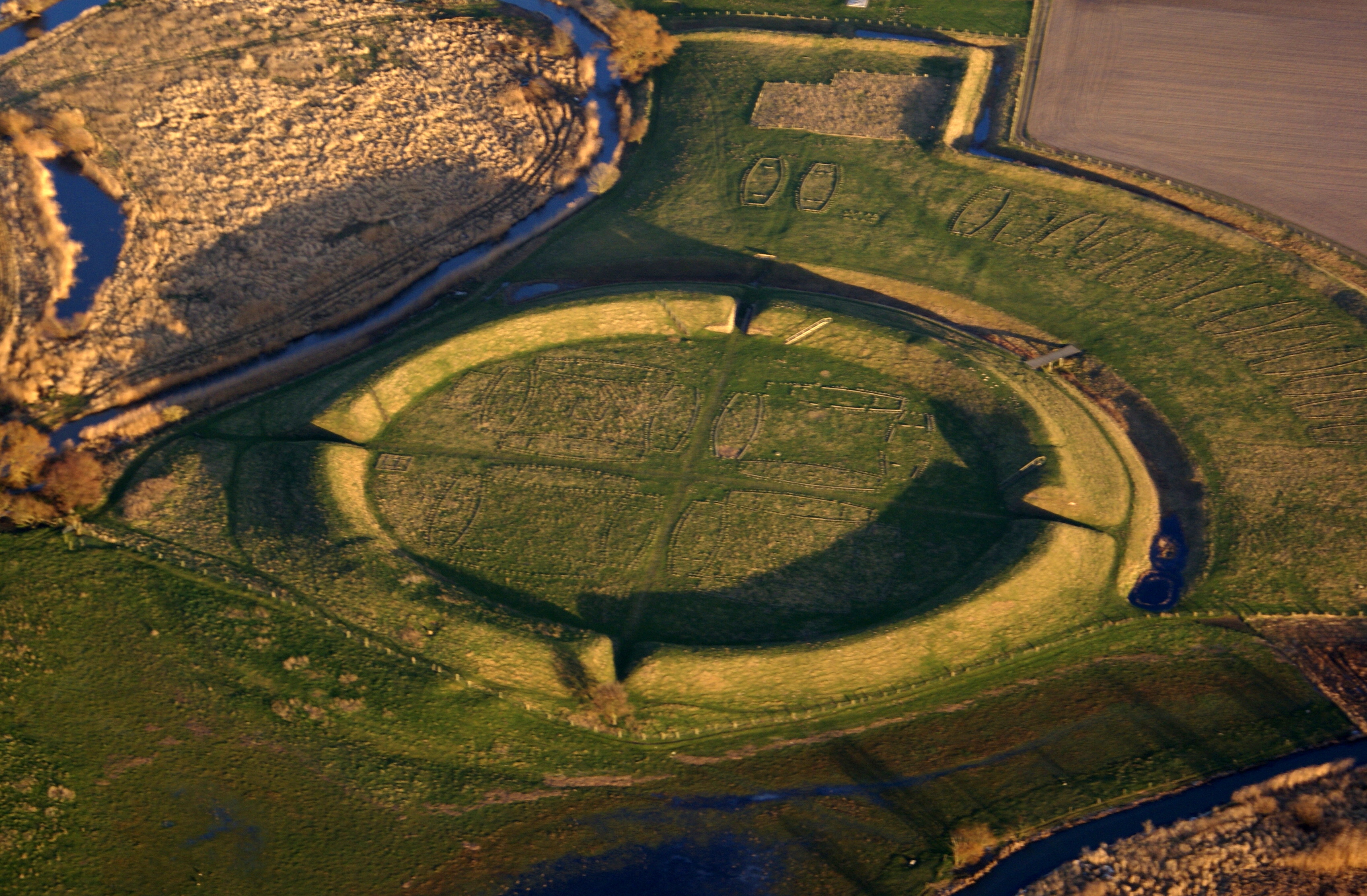
Dendrochronology has dated the work with rare precision: the oaks were cut in the autumn of 980, which points to building the following spring. The result was a study in geometry — a strictly circular rampart roughly 137 metres across, pierced by four gates at the cardinal points and divided by two intersecting streets into quadrants, each filled with longhouses arranged around a square. An outer ward held further houses and a cemetery.
Excavations between 1934 and 1942 recovered the tools of daily life — combs, keys, whetstones, loom weights — together with traces of metalworking and weapons. Arrowheads driven into the ramparts hint at fighting, and the graves, largely of young men, include mass burials; isotope analysis suggests some of the dead came from beyond Denmark.
The fortress stood for only a decade or two before it was abandoned, and its precise purpose — royal display, control of subjects, or a mustering point for campaigns overseas — is still debated. In 2023 Trelleborg was inscribed on the UNESCO World Heritage List alongside Aggersborg, Fyrkat, Nonnebakken and Borgring.
What you will see
The great circular rampart survives as a smooth, grass-covered ring, and from its crest you can read the whole plan of the fortress below: the four gateways, the cross of streets, and the footprints of the vanished longhouses, whose positions are marked on the ground. Just outside the ring stands a full-scale reconstructed longhouse, its bowed walls and steep roof conveying the scale of the timber halls that once filled the interior — though scholars now question some details of its design. Nearby, a reconstructed Viking-age setting hosts hands-on activities in season. The indoor exhibition displays original finds from the excavations, along with models and interpretation of life and warfare within the walls, and there is a shop and café. The low, open ground between old watercourses still makes clear why the site was chosen.
Visiting
Trelleborg lies a few kilometres west of Slagelse in West Zealand, at Trelleborg Allé, and is operated as part of the National Museum of Denmark. By car it is a short drive from Slagelse; by public transport, take a train to Slagelse Station, from where a free bus has run out to the fortress in season — check the timetable before travelling. It is a ticketed open-air museum, though under-18s enter free, and opening is seasonal. For current opening times, prices, the bus schedule and the events calendar, consult the official site (trelleborgvikingeborg.dk). Allow a couple of hours to walk the ramparts and see the exhibition, and dress for open, sometimes windy ground.
Sources