Guide
Historien
Old Scatness sits on a narrow neck of land near Sumburgh, at the very south end of Shetland's Mainland. The site went unrecognised until the late 1970s, when work on an access road serving the expanding Sumburgh Airport cut into the buried settlement and exposed part of the broch wall. Systematic excavation began in 1995, after the Shetland Amenity Trust acquired the ground and invited the University of Bradford to dig; the campaign ran across eleven summer seasons, worked by professional archaeologists, students and local volunteers.
At the heart of the site stands an Iron Age broch, a tall drystone roundhouse whose walls are close to four metres thick and still survive to a similar height. Radiocarbon dates from the excavations — including one on a barley grain and another on bone from the building's lowest courses — place the broch's construction at roughly 400 to 200 BC, in the middle of the Iron Age, making Old Scatness important evidence for when these monumental towers were raised. Around the broch spread a dense village of wheelhouses and cellular buildings, added and rebuilt over many generations.
Occupation did not end with the Iron Age. The settlement carried on through the Pictish period, and then into the Viking and Norse age, when Scandinavian incomers settled among and reused the earlier structures rather than sweeping them away. Viking-age finds recovered from several of the older buildings reflect this Norse presence, and activity continued into medieval and later centuries, including a 17th-century corn-drier. Old Scatness therefore offers a rare, layered record of northern life across more than two thousand years.
Hva du får se
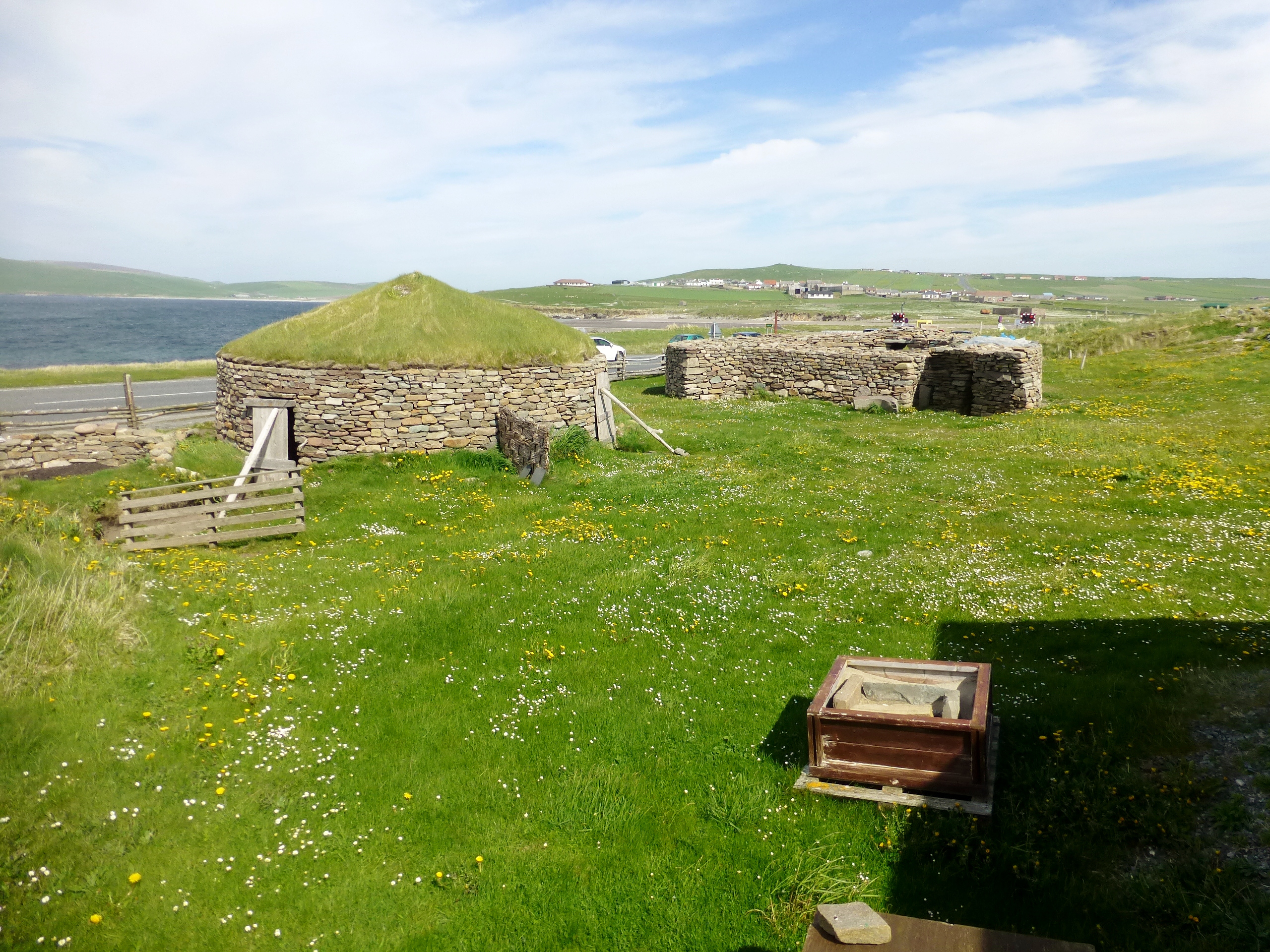
The dominant feature is the broch itself, a massive drystone tower whose wall survives to nearly four metres and which is ringed by a deep defensive ditch. Clustered tightly around it are the excavated footings of wheelhouses and other cellular Iron Age and later dwellings, so you walk among a compact honeycomb of stone rooms, passages and hearths. Interpretation on site helps distinguish the successive Iron Age, Pictish and Norse phases layered into the mound. During the summer season the Shetland Amenity Trust adds reconstructed Iron Age and Pictish buildings, costumed guides and demonstrations of ancient crafts, giving a vivid sense of how the settlement functioned. The dramatic coastal setting beside Scat Ness, with the sea close on either side and Sumburgh Head nearby, is part of the experience.
Besøk
Old Scatness lies just off the A970 near Sumburgh, at the southern tip of Shetland's Mainland, immediately beside Sumburgh Airport and roughly 40 km south of Lerwick. It is easiest reached by car, and combines well with the neighbouring sites of Jarlshof and Sumburgh Head. The site is managed by the Shetland Amenity Trust, which runs a seasonal visitor offering — guided tours, reconstructed buildings and craft demonstrations — chiefly during the summer months rather than year-round. For current opening dates, admission arrangements and any charges, check the official Shetland Amenity Trust and Shetland.org pages before travelling rather than relying on assumptions.
Kilder