Guide
Historien
Eketorp rose on the open limestone plain of southern Öland around AD 300, one of some nineteen ringforts that once studded the island. Archaeologists distinguish three phases of use. Eketorp I (roughly AD 300–400) was a modest circular refuge beside a lake long associated with animal offerings. Eketorp II (roughly AD 400–650), built on the same spot during the Migration Period, was far larger, about 80 metres across, and became a densely packed fortified village: dozens of stone-walled dwellings, storehouses and byres crowded inside the ring, home year-round to a community that kept cattle, sheep, goats, horses and pigs.
The fort was then abandoned for centuries. Its walls were raised again around AD 1170 and, as Eketorp III, the site served through the late twelfth and thirteenth centuries as a garrisoned stronghold before falling out of use around 1240.
Because the whole enclosure was excavated between 1964 and 1974, Eketorp yielded an exceptional record, tens of thousands of finds spanning nearly a millennium of northern Baltic life. That span means the Viking Age itself falls largely within a gap in occupation; Eketorp's greatest significance lies in illuminating the centuries on either side, from Migration-Period farming communities to a medieval refuge, rather than a purely Norse chapter.
Hva du får se
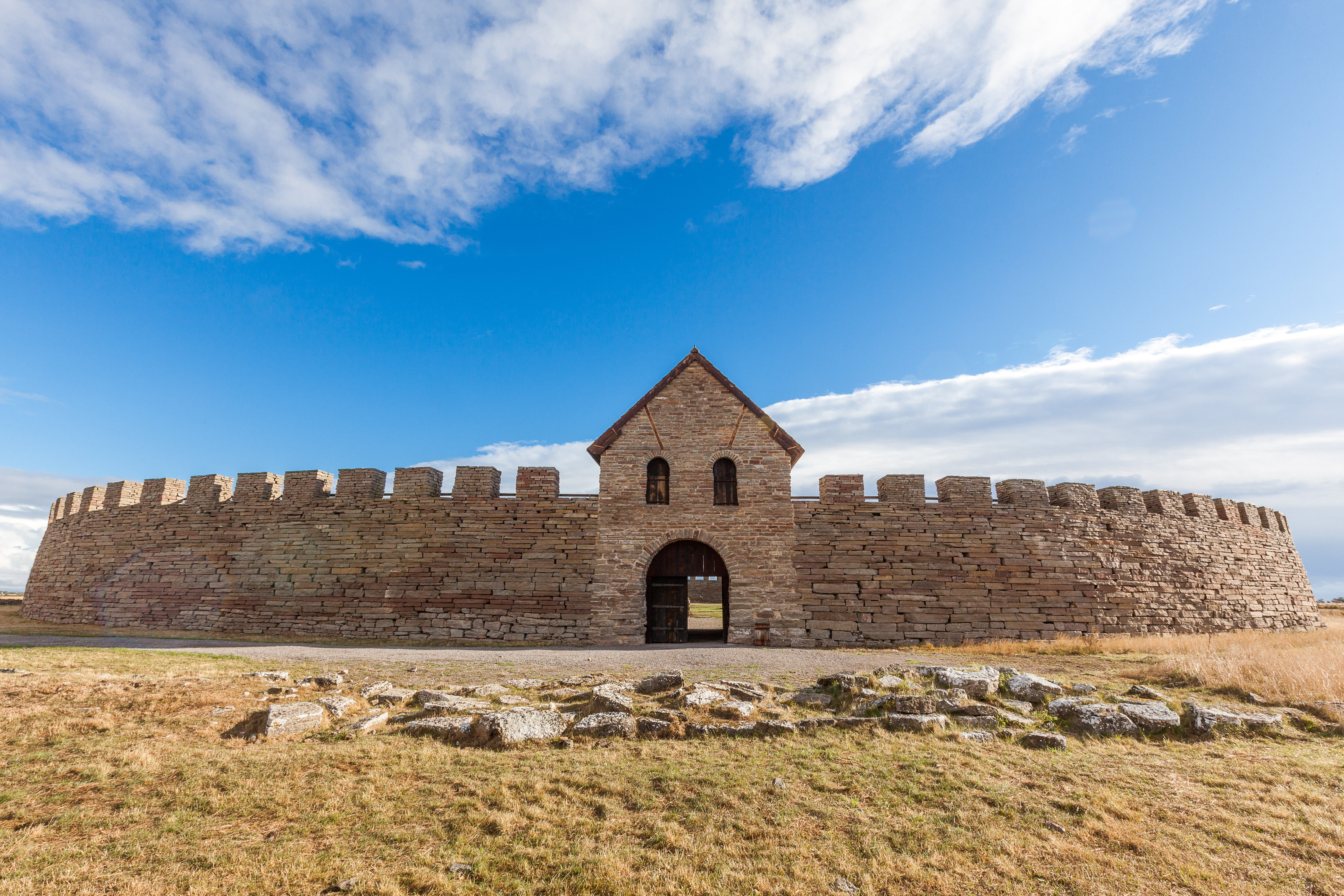
Visitors see a striking reconstruction rather than bare ruins. Since 1978 much of the fort has been rebuilt directly on its excavated foundations: the encircling drystone wall, its gateways, and clusters of low stone-and-turf houses that recreate the crowded interior of the Migration-Period village. Inside the ring you can walk between dwellings, byres and storehouses, examine hearths and reconstructed interiors, and get a vivid sense of how tightly people, animals and stores were packed behind the defences. In summer the fort becomes a living-history site, with costumed interpreters, domestic animals, and demonstrations of crafts such as baking, textile work and smithing. The surrounding flat alvar landscape, itself part of a UNESCO-listed agricultural landscape, makes the isolated circular fort visible from a distance across the plain.
Besøk
Eketorp lies near the southern tip of Öland, in Gräsgård parish within Mörbylånga Municipality, reached by car via road 136 down the island's west side; the nearest larger towns are Mörbylånga and Färjestaden to the north, with Öland connected to Kalmar on the mainland by bridge. The site operates as a ticketed museum with a visitor centre, café and shop, and is a seasonal attraction that is most active in summer when reenactments and family activities run. Opening dates, admission prices and event schedules vary by year and season, so check the official museum website before travelling rather than relying on fixed hours.
Kilder