Leiðarvísir
Sagan
On 6 January 2007, father-and-son metal-detectorists David and Andrew Whelan came upon a lead-wrapped bundle in a field near Harrogate, North Yorkshire. Sensing its significance, they lifted it largely intact and reported it, allowing archaeologists to excavate the contents carefully. The find was later declared Treasure and jointly acquired by the British Museum and York Museums Trust.
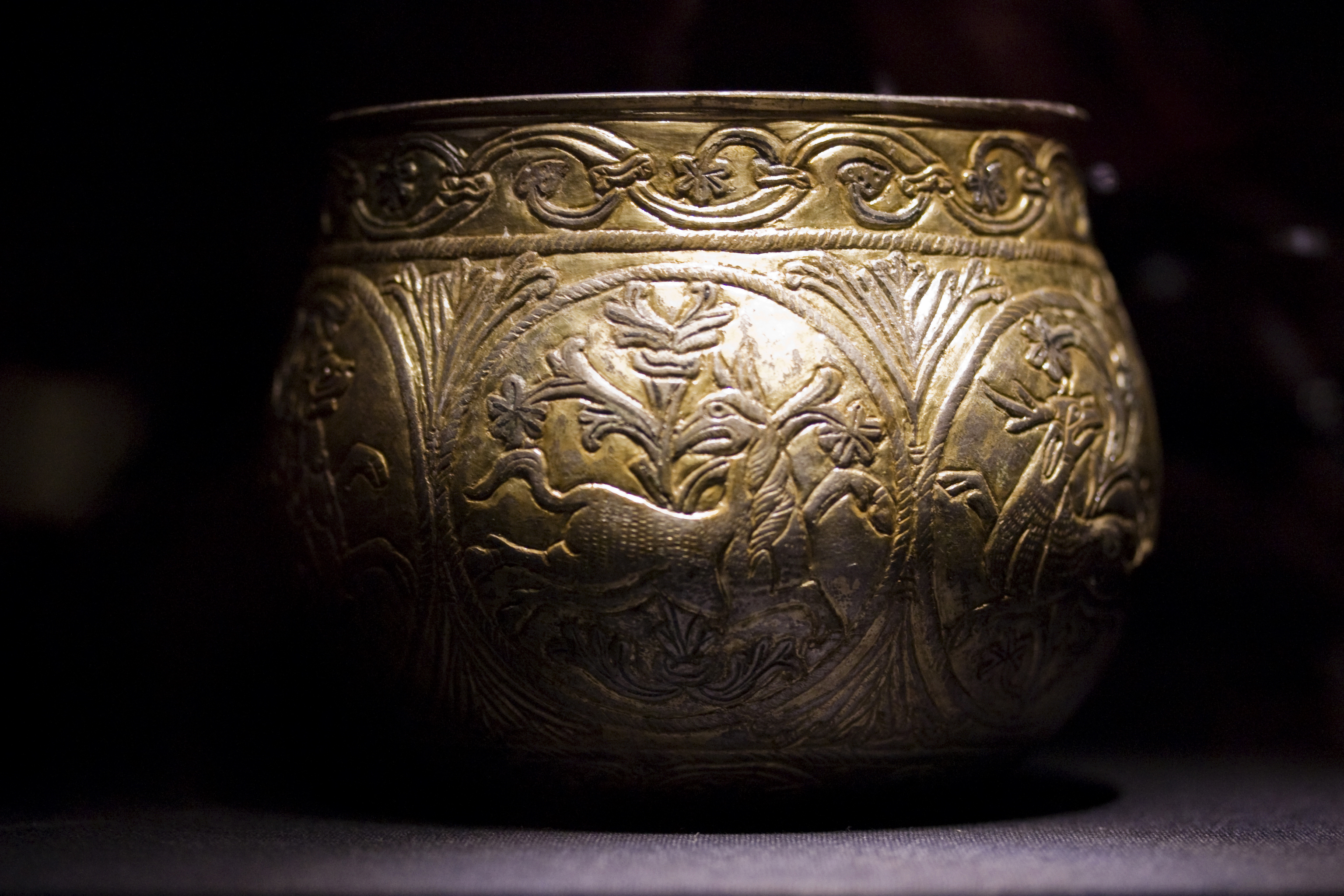
Most of the collection had been stowed inside a gilt-silver vessel of Frankish, Carolingian workmanship, most likely a church cup made in the mid-ninth century and probably taken from a continental monastery during Viking raiding. Around and within it lay 617 silver coins, a rare gold arm-ring, silver ingots and hacksilver, the whole cache sealed in a sheet of lead that helped preserve it.
The hoard was buried around 927-928 CE, a moment of upheaval when the Anglo-Saxon king Athelstan seized the Viking kingdom of York. Its owner, plausibly a wealthy Scandinavian leader, may have hidden the wealth for safekeeping and never returned. The coins and objects span an extraordinary geography, with material and influences reaching from Anglo-Saxon England and Ireland to Scandinavia, the Frankish realm, and the Islamic world. Together they illuminate the trading reach, mixed beliefs and turbulent politics of Viking-age northern England, and rank among the finest such discoveries in Britain in over a century and a half.
Hvað þú sérð
The hoard is displayed together in the Yorkshire Museum in York, not at the findspot, which was kept confidential and lies on private farmland with nothing to see. In the museum's medieval gallery you can view the centrepiece gilt-silver cup, its surface worked with vine-scrolls, foliage and running animals and gilded inside, alongside the gold arm-ring and a dense array of silver coins and cut hacksilver fragments. Interpretation panels trace where the objects came from and explain how such wealth was assembled and concealed. Seeing the coins massed together conveys the scale of the cache, while the cup rewards close looking for its fine continental craftsmanship. Some pieces have at times been shown at the British Museum in London, so check which items are currently on display before visiting.
Heimsókn
The hoard is held by the Yorkshire Museum, set in the Museum Gardens in central York, about a ten-minute walk from York railway station and easily reached on foot from the city centre. York is well served by train from Leeds, Manchester and London. Entry to the Yorkshire Museum is ticketed, and displays can change, so confirm current opening hours, admission prices and which objects are on view via the museum's official website (yorkshiremuseum.org.uk) before travelling. The original findspot near Harrogate is undisclosed and not accessible to visitors. If you also want to explore Viking York more widely, the city offers several related attractions within easy reach.
Heimildir