Leiðarvísir
Sagan
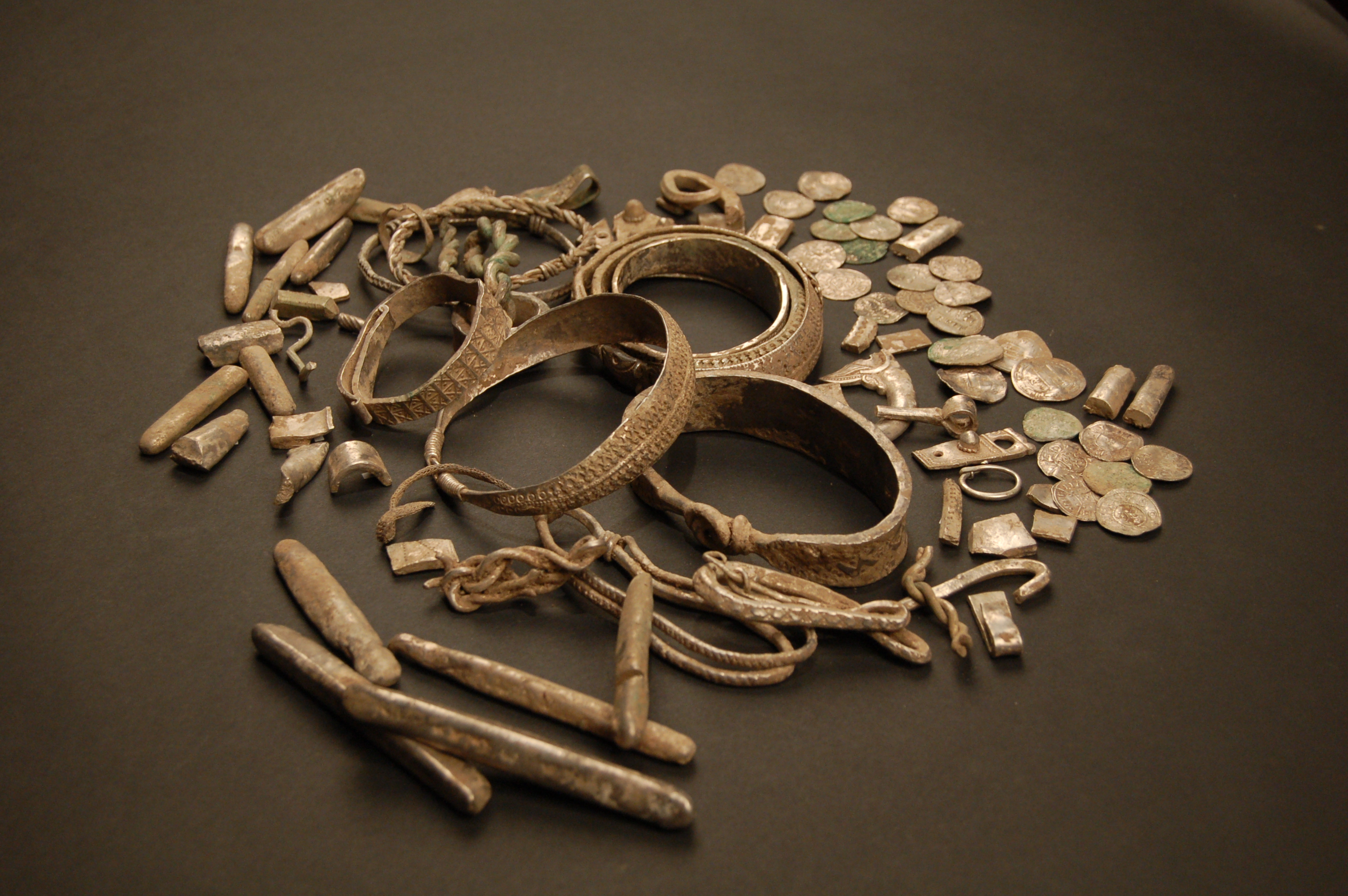
In September 2011 a metal detectorist, Darren Webster, uncovered a lead container buried in a field near the north Lancashire village of Silverdale. Packed inside and beneath it lay more than 200 pieces of silver weighing around a kilogram: arm-rings, finger-rings, brooch fragments, ingots, a braided wire ornament, 27 coins, and quantities of "hacksilver" (deliberately chopped-up pieces used by weight as bullion).
The assemblage dates to roughly AD 900, during the turbulent decades when Anglo-Saxon Wessex and the Scandinavian settlers of northern England contested control of the region. Such hoards were the working wealth of the Viking economy, and a buried cache like this most likely reflects an owner stashing valuables in an unstable time and never returning.
The hoard's celebrated object is a single silver coin stamped with the name AIRDECONUT, thought to render the Scandinavian name Harthacnut. Its reverse arranges the words DNS (Dominus) and REX in the shape of a cross, hinting at a Christian Viking ruler in northern England who was otherwise entirely unknown to history.
Declared treasure and valued at around £110,000, the hoard was acquired for the public by Lancashire's museum service in 2013. It matters because it fixes both a lost ruler's name and a vivid snapshot of a frontier society trading, fighting and hiding its silver.
Hvað þú sérð
There is nothing to see at the find spot itself: it was an ordinary farm field, its exact location kept unpublished, with no marker, mound or monument. The hoard is a museum object rather than a place. What rewards a visit is the silver itself when on display: the nested arm-rings and bangles, the plain and decorated ingots, tangled fragments of hacksilver still bearing test-nicks and cut marks, and the small lead container that held everything underground. The star exhibit is the Airdeconut penny, whose cross-shaped inscription is best appreciated close up alongside the interpretation panels. Check current displays before travelling, as the collection has toured between venues including Lancaster and, more recently, the Jorvik Viking Centre in York, and is not always on permanent public show.
Heimsókn
The hoard belongs to Lancashire's museum service and has been shown at venues in Lancaster and at the Jorvik Viking Centre in York rather than at any site in Silverdale itself, so confirm where it is currently displayed before planning a trip. The village of Silverdale sits within the Arnside and Silverdale National Landscape near Morecambe Bay, reached by train on the Furness line (Silverdale station) or by road from junction 35 of the M6. For up-to-date opening times, admission charges and which objects are on view, consult the official Lancashire County Council museums pages or the hosting museum's website; do not rely on unofficial listings, as displays and loans change.
Heimildir