Leiðarvísir
Sagan
Sigtuna rose around 980 CE on a bay of Lake Mälaren, laid out as a planned royal town whose houses stood on long, regular narrow plots ranged along a single main street. It appears to have been founded as a successor to the recently abandoned trading centre at Birka and to anchor royal power in the province of Uppland. Dendrochronology dates some of its central buildings to about 981. Tradition credits King Erik the Victorious with its foundation, though the town is most tangibly linked to his son, Olof Skötkonung.
Around the year 1000, during Olof's reign, a mint at Sigtuna struck what are generally regarded as Sweden's first coins, several of them naming the town as the place of minting. Sigtuna was also an early Christian centre: cemeteries and, by around 1100, stone churches dedicated to saints including Peter and Olaf mark its conversion-era importance, and a bishop is recorded here in the 1060s. Writing around 1070, Adam of Bremen called the town a great city (civitas magna).
Excavations across the town have yielded runic-inscribed objects, imported goods and workshop debris, and Sigtuna and its surrounding district hold one of the densest concentrations of runestones anywhere. Genetic and strontium-isotope analysis of skeletons from its early cemeteries, dating to the 10th to 12th centuries, found that roughly half of those examined were migrants, some from elsewhere in Scandinavia and others from as far as the British Isles and the region of present-day Ukraine, while the remainder were local to the Mälaren area, portraying late-Viking Sigtuna as a strikingly mixed community. Post-glacial land uplift gradually left its harbour too shallow to use, and the rising town of Stockholm eclipsed it from the 13th century onward.
Hvað þú sérð
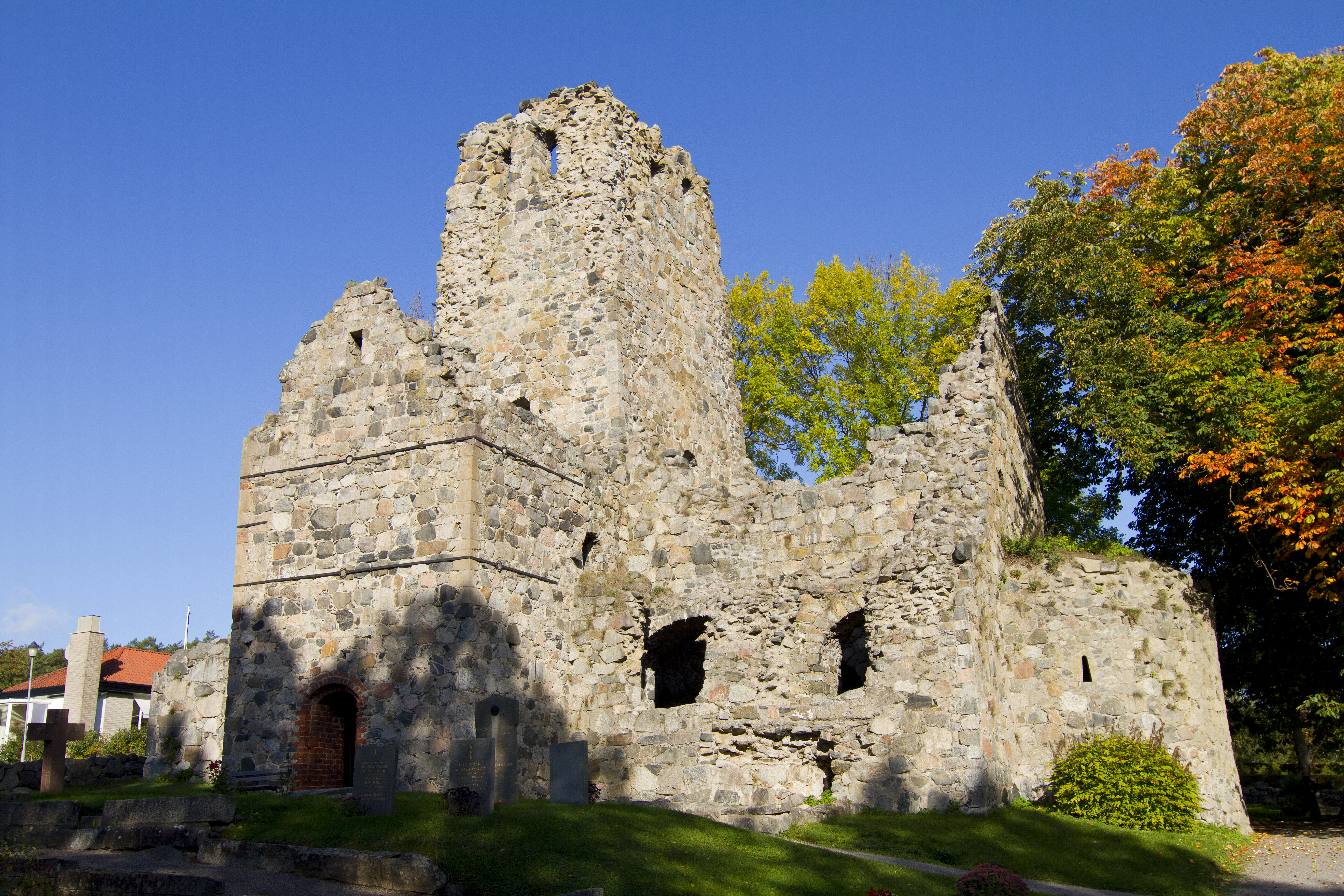
Sigtuna's medieval street plan survives remarkably intact. Stora Gatan, the main street, still follows its old line, lined now with low wooden houses and shops. The town's signature sights are its ruined stone churches: the roofless shells of St Per (St Peter) and St Olof, both raised around 1100, stand as gaunt towers and arches among lawns and old graves. Scattered through parks, churchyards and along the streets are numerous rune-carved stones, several with legible inscriptions; Sigtuna is famous for having one of the highest densities of standing runestones of any town. The Sigtuna Museum displays coins from the local mint, everyday Viking-age objects and finds from the excavations. Around the medieval brick church of Mariakyrkan (St Mary's), built in the 13th century by the Dominican order, the compact old town rewards slow wandering on foot.
Heimsókn
Sigtuna sits about 40 km north-west of Stockholm and close to Arlanda Airport, in Sigtuna Municipality (Uppland, Stockholm County). It is most easily reached by car, or by train from Stockholm with a change at Märsta followed by a local bus into the old town; boat tours also cross Lake Mälaren from Stockholm in summer. The old town, its main street, church ruins and runestones are outdoors and free to explore year-round. The Sigtuna Museum interprets the finds. Opening times, admission and guided-tour availability vary by season, so check the official Sigtuna Museum and Destination Sigtuna websites for current details before visiting. Sturdy shoes are useful for cobbles and grass.
Heimildir