Leiðarvísir
Sagan
Raknehaugen is the largest prehistoric mound in Scandinavia: a grassed dome roughly 77 metres across and more than 15 metres high, built from tens of thousands of cubic metres of sand and turf. Beneath that earth lies its real marvel — a hidden lattice of tens of thousands of stacked logs. Dendrochronology shows that almost all of the timber was felled in a single winter in the mid-500s AD, placing the monument in the Migration Period, generations before the Viking Age proper opened around 793.
Local tradition long tied the mound to a legendary king named Rakni, and archaeologists dug in search of his grave in 1869–70, 1939–40 and again in 1993; the carbon-14 dating carried out here in 1956–57 was the first ever done in Norway. Yet no convincing burial chamber has come to light. A little cremated bone recovered from the mound was later dated to the Bronze Age — roughly 1,800 years older than the monument itself — which only deepens the doubt that Raknehaugen was ever a grave.
The scale of the felling — thousands of trees of similar age cut in a single season — is the earliest evidence yet found for forestry on this scale in Iron Age Scandinavia. A 2026 study drew on LiDAR data to trace a large landslide scar beside the mound and recast the monument as a communal, ritual response to disaster amid the climate crisis that followed the 536 AD dust-veil event, rather than the tomb of a single ruler. That debate is still open.
Hvað þú sérð
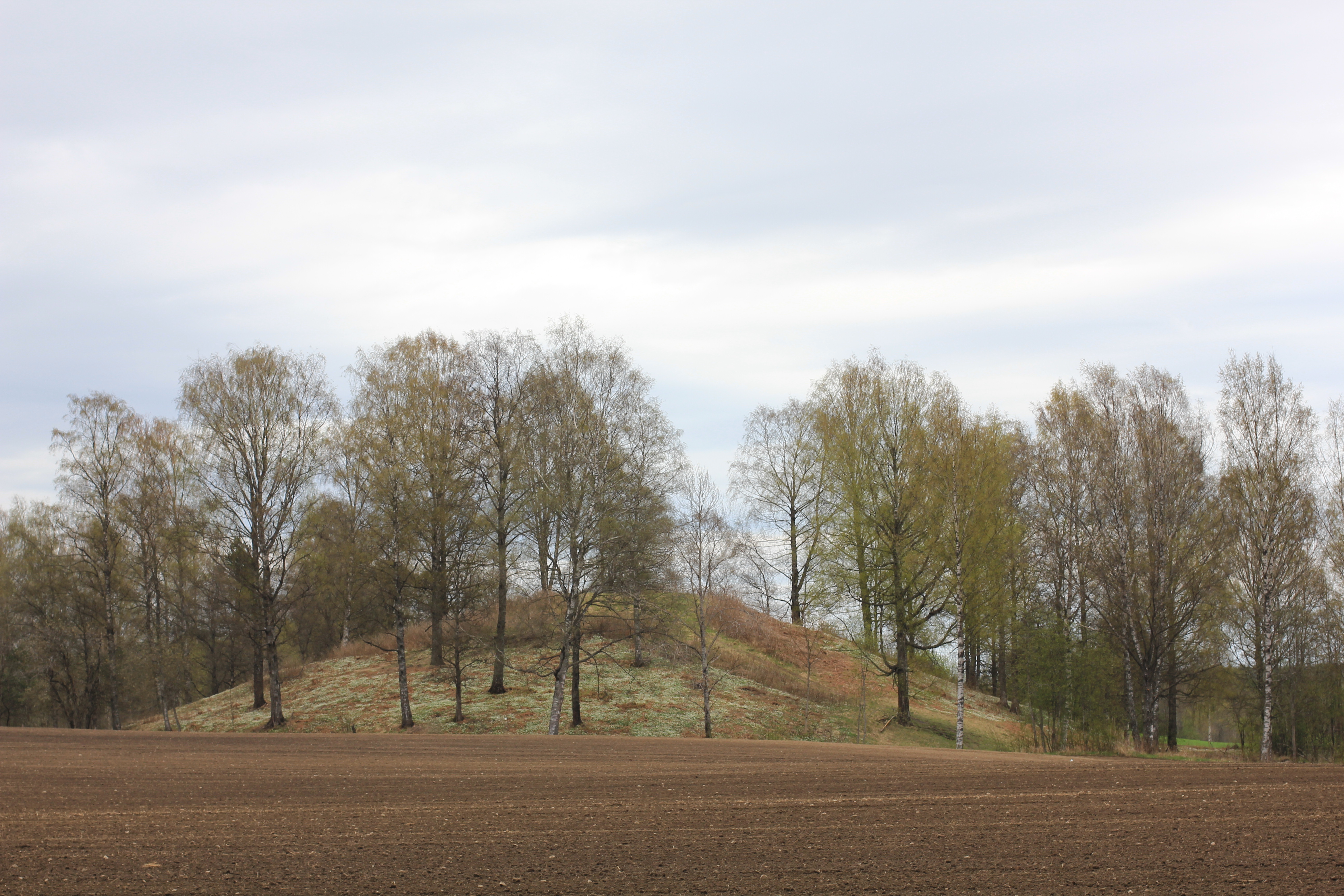
Approached across the flat farmland and woods of Romerike, Raknehaugen reads at first like a low natural hill — a broad, tree-covered dome that climbs steeply from the surrounding fields. A path leads up the grassed slope to a level summit with open views across the lowlands. There is no built monument on top today: a hexagonal stone pavilion raised here as a family memorial in 1808–09 was pulled down around 1850 and its stones carted off for reuse, so nothing of it survives. What made Raknehaugen famous — the vast timber lattice within and the objects from the old excavations — is not on show; the wood lies sealed beneath the earth and the finds are held in museum collections. The ancient landslide ground that recent research ties to the monument is likewise difficult to pick out at ground level.
Heimsókn
Raknehaugen sits in rural Ullensaker in Akershus, eastern Norway, a short drive from Jessheim, the municipal centre, and close to Oslo Airport Gardermoen (OSL) — handy for a stopover. It is easiest to reach by car, with parking nearby, and the Pilegrimsleden (St Olav Ways) pilgrim route passes the site. The mound is an open-air heritage monument, freely accessible year-round with no admission charge, and there is no staffed visitor centre or fixed opening hours on site. For directions, access details and any guided-walk information, check the official Pilegrimsleden listing and Ullensaker municipality's tourist information rather than relying on unofficial times.
Heimildir
- Rakni's Mound — Wikipedia ↗
- Rakni's Mound (Q2944431) — Wikidata ↗
- The Late Iron Age Mound Raknehaugen in Norway: A Ritual Response to the Sixth-Century Crisis — European Journal of Archaeology (Cambridge Core) ↗
- Scandinavia's largest 'burial mound' may be a monument to catastrophe, not a king — Phys.org ↗
- Raknehaugen — Pilegrimsleden (St Olav Ways) ↗