Leiðarvísir
Sagan
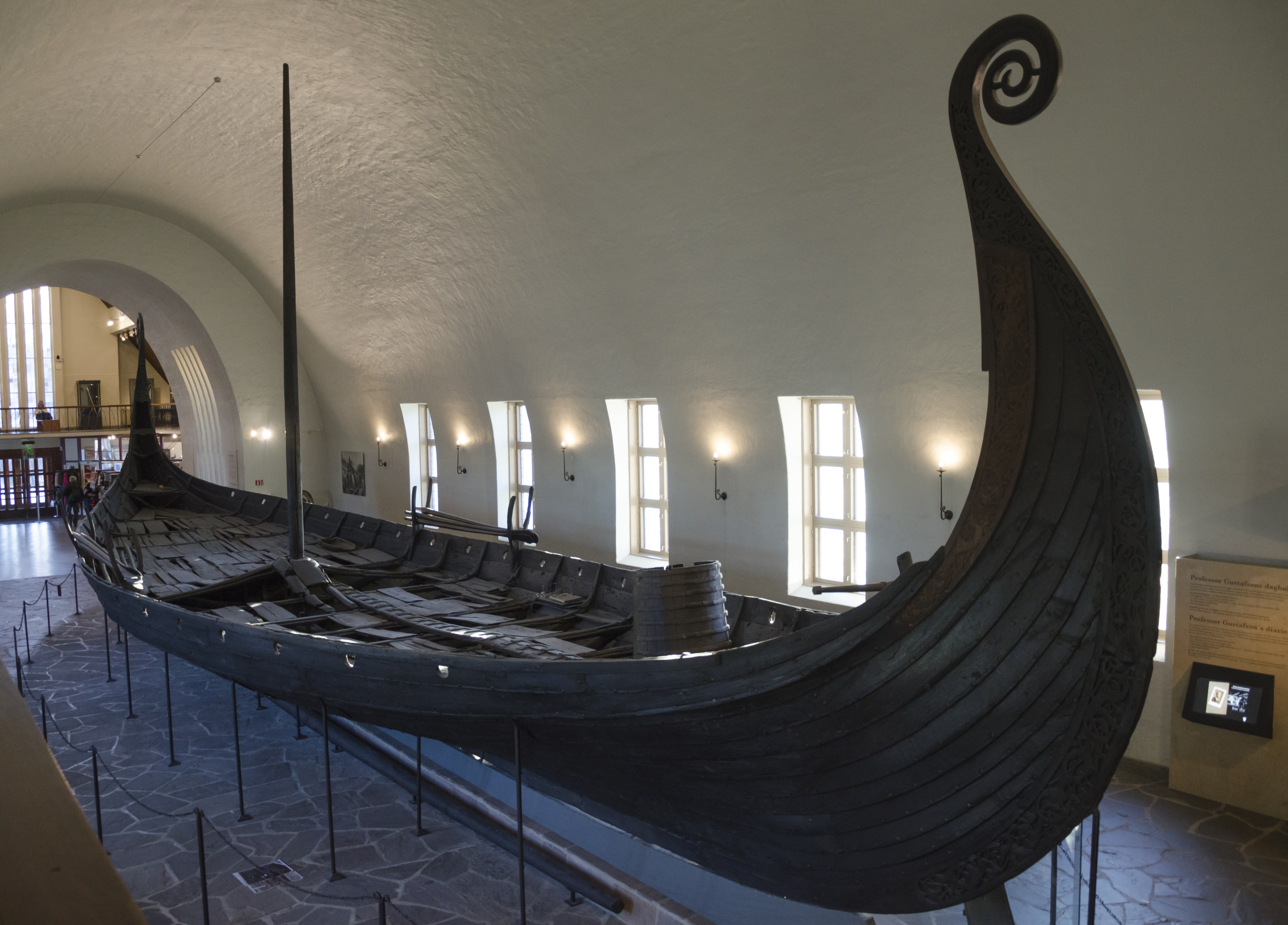
The Oseberg mound (Oseberghaugen) once rose beside the farmland of the Slagen valley northeast of Tønsberg, heaped over one of the richest graves the Viking world has produced. Beneath it lay a clinker-built oak ship roughly 21.5 metres long, a sleek karve rigged for fifteen pairs of oars, its prow and stern coiling into carved spirals. Dendrochronology dates the ship's construction to around 820 CE and the burial itself to the autumn of 834.
The dead were two women, laid together on a bed inside a timber chamber. One was elderly, the other somewhat younger; their names are lost. With them went an astonishing trove: an ornately carved four-wheeled cart, four decorated sledges, beds and chests, looms and kitchen equipment, woven tapestries, imported silks, and a wooden pail whose brass handle-mount carries a cloisonné-enamel figure — the so-called "Buddha bucket". Fourteen horses, an ox and three dogs were sacrificed and laid alongside them. Robbers had broken into the chamber in antiquity, stripping its precious metals and scattering the bones.
Excavated in 1904–05 by Gabriel Gustafson and Haakon Shetelig, the ship survived because waterlogged blue clay had preserved its woodwork remarkably, and it lent its name to the flowing "Oseberg style" of animal ornament. Who the women were is still debated — tradition names Queen Åsa, grandmother of Harald Fairhair, while others suggest a priestess or völva — yet there is no doubt this was an elite Norse burial, and it ranks among the greatest finds of its age.
Hvað þú sérð
At Slagen, the mound itself is what remains: a broad grassy barrow, roughly 40 metres across and a few metres high, rebuilt in 1947 after the excavation levelled it. Set among farm fields near Slagen church, it is marked by information boards and a bench or two — quiet and unstaffed, open to the sky rather than a museum in its own right. The ship and its treasures are not here. They were taken to Oslo, where the excavated hull, cart, sledges and carved animal-head posts are conserved and displayed. In Tønsberg you can meet more of the story: the Slottsfjell Museum holds a copy of the ship's richly carved bow, and the full-scale sailing replica Saga Oseberg, launched in 2012, is often moored in the town's harbour and sometimes taken out under oar and sail.
Heimsókn
The mound lies about 5 km northeast of Tønsberg, the nearest town, in Vestfold — roughly a 1.5-hour drive south of Oslo. It sits in open countryside off the Slagen road and is free to visit at any time; there is no ticket, gate or visitor centre at the barrow itself, so treat the surroundings as working farmland and keep to marked paths. The original Oseberg ship is in Oslo at the Museum of the Viking Age (Vikingtidsmuseet) on Bygdøy, which is closed for a major rebuild and is expected to reopen in 2027 — check the museum's official website for current status before you travel. For nearby finds and replicas, enquire at Tønsberg's Slottsfjell Museum.
Heimildir