Leiðarvísir
Sagan
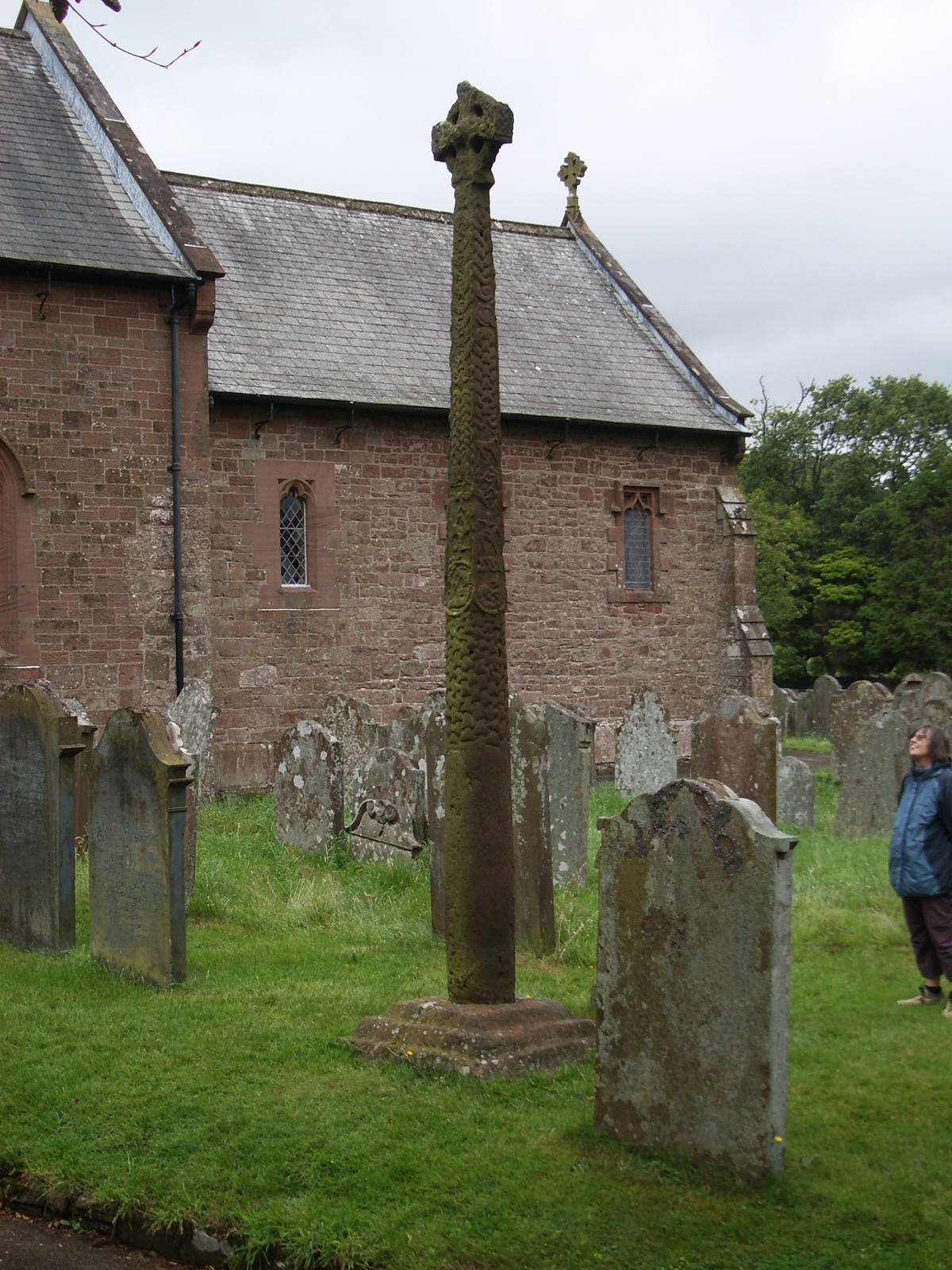
The Gosforth Cross was carved in the first half of the 10th century, roughly 920 to 950 CE, during the era when Norse settlers of Scandinavian and Hiberno-Norse descent were putting down roots along the Cumbrian coast. Cut from local red sandstone and rising some 4.4 metres, it is remarkable for having survived almost complete, and for the quality and detail of its low-relief carving, unusual among the many stone crosses of the region.
What sets it apart is its imagery. Alongside a crucifixion scene, the shaft carries figures that scholars have read as episodes from Norse legend: a bound figure with a woman holding a vessel above him, widely interpreted as Loki and Sigyn; a figure wrenching apart a beast's jaws, read as Vidarr and the wolf Fenrir; and a horn-bearing figure often identified as Heimdall. Many read these as visions of Ragnarok placed deliberately beside the Christian cross.
The dual meaning was first argued in the 1880s: in 1881 the local antiquarian Charles Arundel Parker drew attention to the carvings, the Reverend William Slater Calverley read the west face as the binding of Loki, and in 1882 the Copenhagen scholar George Stephens endorsed the reading, linking the panels to the Eddic poems. The monument matters as a rare, legible record of a community moving between pagan Norse and Christian belief, choosing to tell both stories on a single stone.
Hvað þú sérð
Visitors find the cross standing in the open churchyard of St Mary's, near the church. It is strikingly tall and thin: a rounded, almost cylindrical lower shaft that squares off higher up, topped by a small ring-head cross. The red sandstone has weathered over eleven centuries, so the carvings are shallow and best read in raking light, but with patience the interlace patterns and figural panels emerge, including the crucifixion and the scenes interpreted as Norse myth. Inside the church, kept out of the weather, are further Viking-age stones, notably two hogback tombstones and carved fragments, along with the so-called "fishing stone." Interpretation boards in the churchyard and church help make sense of the panels. The setting is quiet and rural, framed by the fells of the western Lake District.
Heimsókn
Gosforth village lies in western Cumbria, near the coast and the Lake District's Wasdale approach; the nearest small towns are Egremont and Seascale, with Seascale the closest railway station on the Cumbrian Coast line. The cross stands outside St Mary's Church in the village and can be viewed from the churchyard at any reasonable time, free of charge. The church, which shelters the hogback stones and other carvings, is generally open to visitors during daylight, but check the parish or National Churches Trust listing for current access before travelling. There is no dedicated visitor centre or entry fee. Please treat the churchyard, an active burial ground, with respect. For opening arrangements, services and any donations, consult the official church information rather than relying on third-party sites.
Heimildir