Leiðarvísir
Sagan
On 15 May 1840, workmen repairing an embankment on the south bank of the River Ribble at Cuerdale, a few miles upstream of Preston, struck a lead chest packed with silver. What they found remains the largest Viking-age silver hoard known from Britain or Ireland, on a scale that leaves every other find on these islands far behind.
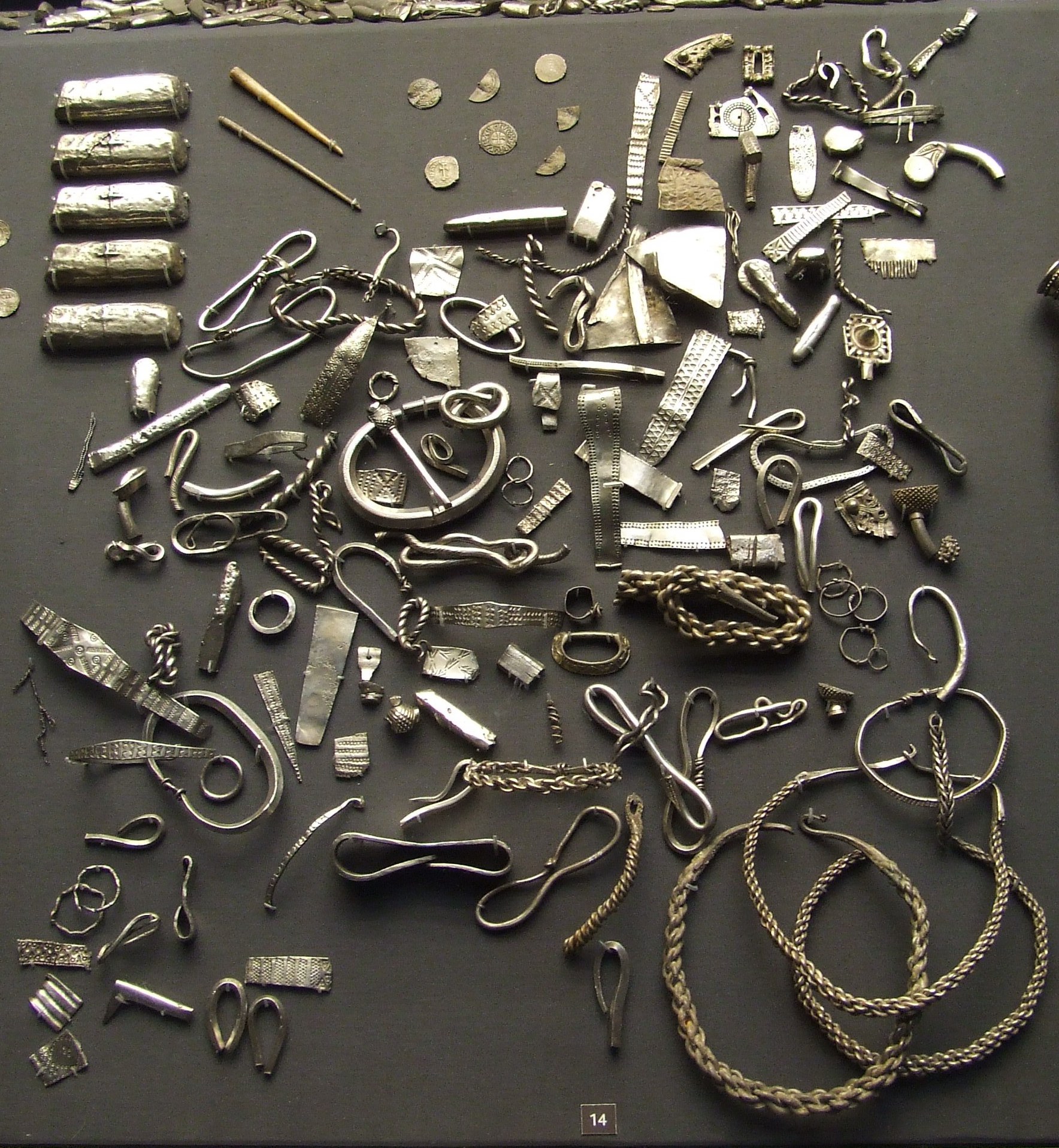
The hoard held more than 8,600 items. Alongside roughly 7,000 coins lay about a thousand ounces of ingots and hacksilver, the chopped and bent fragments of arm-rings, brooches and other ornaments that the Norse used as bullion, weighed out rather than counted. The coins span a remarkable geography: Anglo-Saxon and Viking issues from the British Isles, Carolingian pieces from Francia, and dirhams from the Islamic world far to the east, testimony to the trade and plunder networks that fed the Viking economy.
Numismatic dating places burial around 905-910 CE. Many scholars connect it to the Norse expelled from Dublin in 902, who regrouped around the Irish Sea and the Ribble valley, a natural route between Viking York and the Irish Sea world. Whether it was a war chest, communal treasury or merchant's reserve is debated, but its scale illuminates a turbulent frontier. Most of the hoard is now in the British Museum, with material also at the Ashmolean Museum in Oxford.
Hvað þú sérð
There is little to see at the find-spot itself: Cuerdale is quiet farmland and riverbank beside a bend of the Ribble, with no monument or dedicated viewing point, and the land is private. The hoard's real home is the museum case. In the British Museum's early medieval galleries you can see a substantial selection of the coins, silver ingots and hacksilver, together with the ornaments cut down for bullion, laid out so the sheer quantity and variety register at a glance. The Ashmolean Museum in Oxford displays around sixty pieces within its British archaeology collections. Together these show the hoard's international mix, from Anglo-Saxon and Viking coinage to Frankish issues and eastern dirhams, and the practical business of a silver economy weighed by the gram.
Heimsókn
The find-spot near Cuerdale, off the A59 between Preston and Whalley in South Ribble, is private farmland with nothing to view, so plan your visit around the museums instead. The largest display is at the British Museum in London (free entry; nearest Underground Holborn, Tottenham Court Road or Russell Square). A further group is shown at the Ashmolean Museum in Oxford (also free), a short walk from Oxford city centre and its rail station. Both are major national museums with cafes and step-free access. Opening times and any temporary gallery closures change, so check the official British Museum and Ashmolean websites before travelling rather than relying on third-party listings.
Heimildir