Leiðarvísir
Sagan
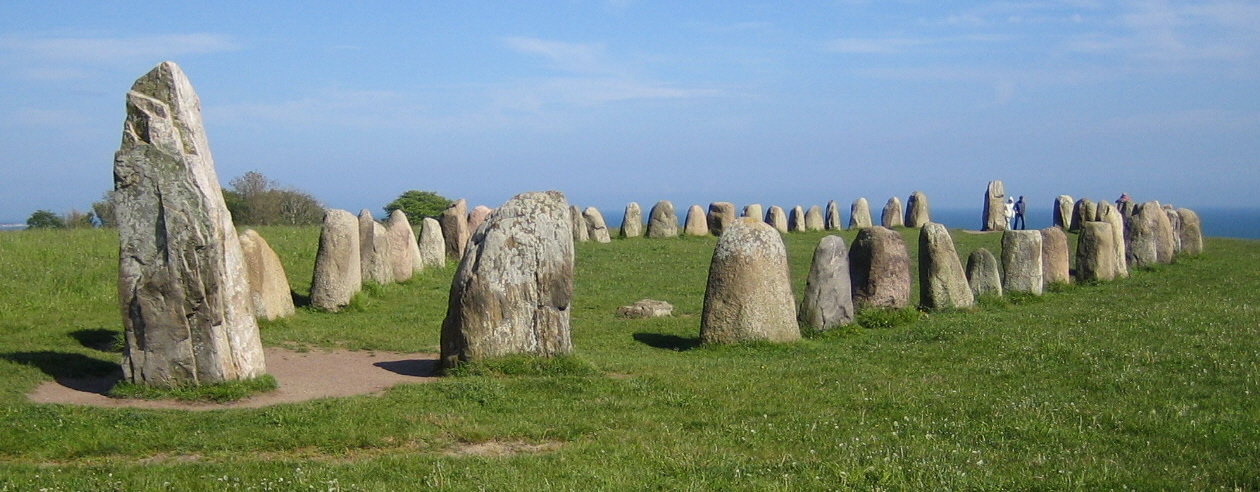
Ales stenar is the largest preserved stone ship in Sweden — 59 boulders, some weighing up to five tonnes, set on end in the sweeping 67-metre outline of a vessel along a windswept ridge above the Baltic near Kåseberga. Prow and stern are marked by the tallest stones, giving the monument the unmistakable silhouette of a ship frozen in the turf.
Its age was long debated. Excavations in 1989, together with radiocarbon dating carried out for the Swedish National Heritage Board, placed the monument in the late Nordic Iron Age, roughly the sixth century CE — a few generations before the Viking Age proper. Six of the seven radiocarbon results clustered around 1,400 years ago; birch charcoal sealed beneath one undisturbed boulder returned a date of about 540–650 CE. A decorated pot holding burnt human bone was recovered from within the ship setting, and the charred food crust inside it fell in the same range — together reinforcing a funerary reading.
Most archaeologists interpret Ales stenar as a grave monument or cult site, in keeping with other large Scandinavian stone ships that mark burials. Its dramatic clifftop setting has also fed enduring speculation — that the stones form a solar calendar aligned to the solstices, or an astronomical instrument. Those astronomical claims remain contested and unproven, but the monument's identity as a Late Iron Age Scandinavian creation is not in doubt. It endures as one of the most striking prehistoric sites in the Nordic world.
Hvað þú sérð
Today the monument stands complete and open on a grassy plateau high above the sea, one of the most photogenic ancient sites in Scandinavia. Fifty-nine grey stones trace a clean 67-metre oval, tapering to taller pointed blocks at the two ends that read clearly as bow and stern. From the ridge the view sweeps over the fishing hamlet of Kåseberga, its small harbour, and the open Baltic — the setting is as much of the experience as the stones themselves. There are no fences or ticket barriers, so visitors can walk right up to and around the ship. Around midsummer and midwinter, enthusiasts gather to watch the sun rise and set past the end stones. Interpretation signs on site outline the archaeology.
Heimsókn
Ales stenar sits on the ridge above Kåseberga, about 10 km southeast of Ystad in Skåne, southern Sweden. From Ystad — reachable by train from Malmö and Copenhagen — follow signs to Kåseberga; there is a large car park by the harbour, from which a signposted footpath climbs roughly 15-20 minutes uphill to the monument. The site itself is outdoors, unenclosed and free to visit year-round. The harbour below has seasonal cafés, seafood kiosks and a small information point. For current facilities, transport and any guided-tour details, check the official Ystad tourism pages before travelling.
Heimildir