Guide
Historien
Repton was already a place of Mercian importance, a royal and monastic centre whose Anglo-Saxon church held the crypt-tombs of kings, when the Viking Great Heathen Army seized it as a winter base in 873. The Anglo-Saxon Chronicle records the army driving the Mercian king Burgred into exile and overwintering here before dispersing the following year.
Excavations by Martin Biddle and Birthe Kjolbye-Biddle between 1974 and 1988 revealed a D-shaped defensive enclosure whose ditch ran to the bluff above the Trent, apparently using the standing church as a fortified gateway, a layout echoing strongholds in the Scandinavian homelands. Around it lay Viking burials. Grave 511 held a man interred with a Petersen type-M sword, a Thor's-hammer pendant and a boar's tusk laid between his legs; his bones carried battle injuries, including a deep cut to the thigh. Nearby, a former Anglo-Saxon building had been remodelled into a burial mound packed with the jumbled, commingled bones of at least 264 individuals, roughly four-fifths of them men aged between about 18 and 45, accompanied by weapons and five silver pennies struck in 872-874.
Radiocarbon dates once seemed to scatter the charnel across centuries, casting doubt on the Viking link. In 2018 a team led by Cat Jarman showed the anomaly stemmed from a marine-reservoir effect, a fish-rich diet making the bones read older; once corrected, the dead fell squarely in the late ninth century. Repton now stands among the most vivid physical records of the army that transformed England.
Hvad du vil se
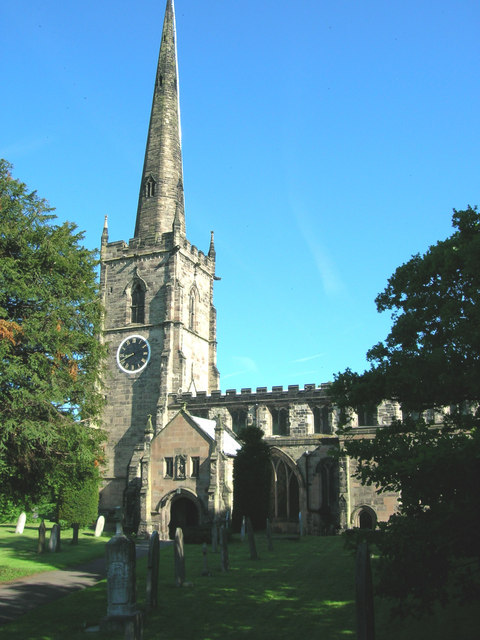
The centrepiece is St Wystan's Church, whose Anglo-Saxon chancel and celebrated crypt survive; the small stone crypt, its four columns wound with spiral fluting, is among the finest surviving Anglo-Saxon architecture in England and served as the royal mausoleum that the Viking army is thought to have drawn into its defences. From the churchyard you can read the ground falling away toward the Trent floodplain, the natural line the Great Army defended. The charnel mound lay in the former vicarage garden and is not presented as an open monument, and the excavated bones and finds are not displayed in situ. Interpretation in the church and its guide explains the Viking episode. The compact medieval village core, the base of a village cross and the historic grounds of Repton School complete a walkable centre steeped in both Mercian and Norse history.
Besøg
Repton lies just south of the River Trent in South Derbyshire, near Burton upon Trent and within easy reach of Derby; the closest railway station is Willington, a short distance north across the river, with local buses serving the village. St Wystan's Church and its Anglo-Saxon crypt are generally open to visitors and free to enter, though crypt access can vary and donations are welcomed. There is no dedicated Viking visitor centre on site, and the burial locations are not open attractions. Village street parking is limited, so park considerately. For current opening times, service schedules and any guided-tour arrangements, consult the official St Wystan's Church website rather than relying on third-party listings.
Kilder