Guide
Historien
The Bedale Hoard came to light on 22 May 2012, when two metal detectorists working a field near the market town of Bedale in North Yorkshire uncovered a cache of precious metal. Reported through the Portable Antiquities Scheme and later declared treasure under the Treasure Act 1996, the find comprises 48 gold and silver items broadly dated to the late ninth and early tenth centuries, the period when much of northern England lay under Scandinavian rule.
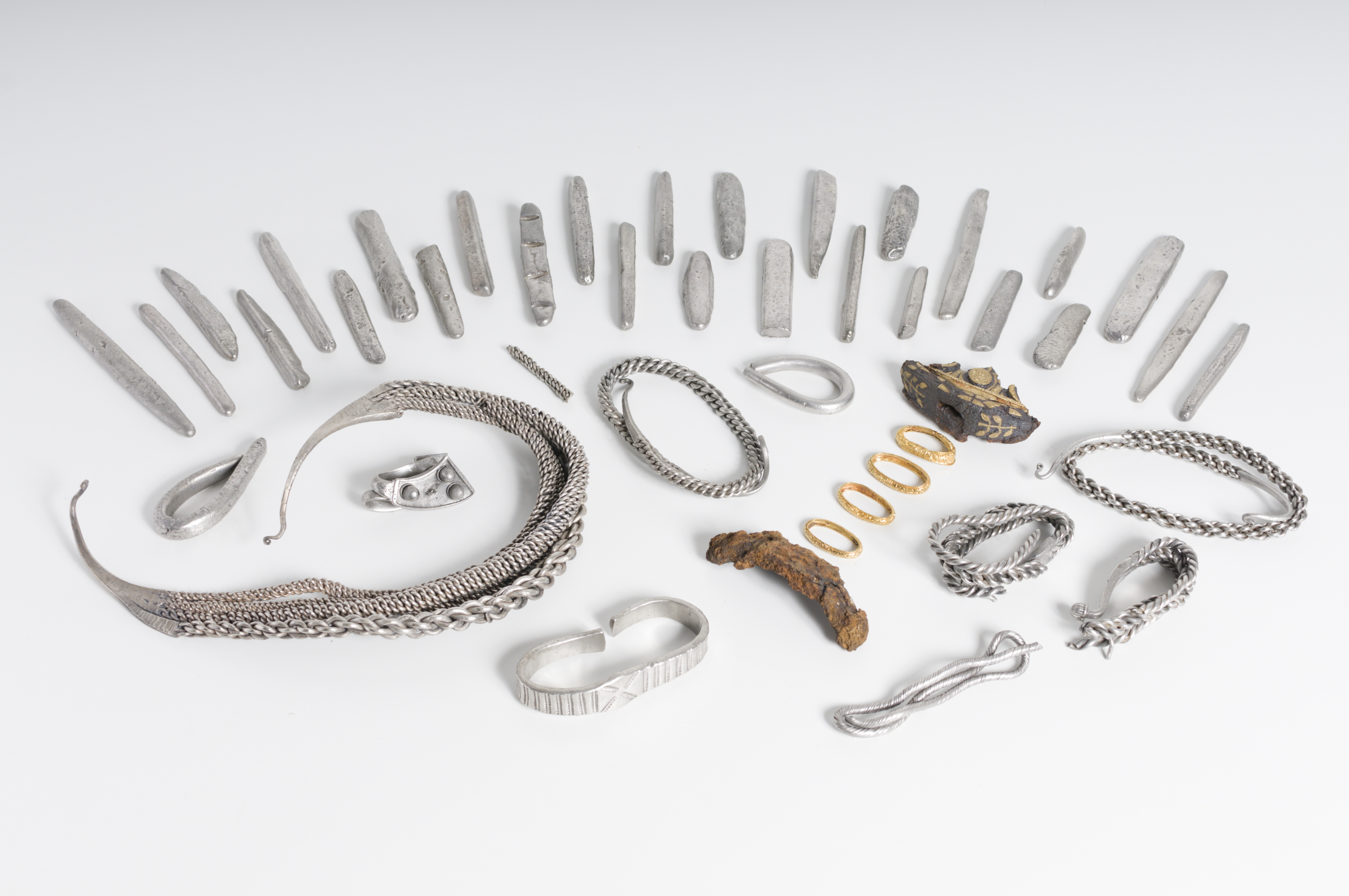
Among the objects are 29 silver ingots of varying weights, several silver neck-rings and collars, a silver arm-ring, a penannular brooch and pieces of hacksilver. The most celebrated piece is an iron sword pommel inlaid with plaques of gold foil, accompanied by four gold hoops and six rivets from the same hilt, its animal ornament recalling the Anglo-Saxon Trewhiddle style of the late ninth century.
What makes the assemblage remarkable is its geographic reach. Alongside British and Anglo-Scandinavian pieces, an arm-ring reflects Irish workmanship, while a fragment of a "Permian" ring points eastward toward Russia, evidence that the silver economy of Viking Yorkshire drew on trade and plunder across a vast network; later scientific study of the metal has traced it to British, French and even Islamic Middle-Eastern sources. Whether buried for safekeeping or as a store of bullion, the hoard was never reclaimed. Conserved by York Archaeological Trust, it was acquired by the Yorkshire Museum for £50,000 following a public appeal and went on display in 2014, where it now anchors displays of the region's Viking past.
Hvad du vil se
There is nothing to see at the rural findspot itself, which is not marked or publicly identified. Instead, the hoard is displayed at the Yorkshire Museum in York, where the conserved objects are shown together in the Medieval Gallery. Visitors can study the silver ingots and neck-rings alongside the star piece, the gold-foil-inlaid iron sword pommel with its intricate hilt fittings, whose fine ornament was only fully revealed during cleaning. Interpretation sets the treasure in the context of Scandinavian York and the wider Viking world, explaining how objects showing Irish, British and eastern influences ended up buried together in a Yorkshire field. Seeing the assemblage as a group conveys both the personal wealth and the international trade connections of early tenth-century northern England.
Besøg
The hoard is held at the Yorkshire Museum, set in the Museum Gardens in central York, a short walk from York railway station and easily reached by rail from across Britain. Bedale itself, the nearest town to the findspot, lies further north near the A1 but has no display relating to the hoard. The museum charges admission and operates seasonal opening hours, with occasional changes to gallery displays, so confirm current prices, times and whether the hoard is on show before travelling by checking the official Yorkshire Museum website. York is compact and walkable, making the museum straightforward to combine with the city's other Viking-age attractions.
Kilder